
You Don’t Transform an Enterprise. You Re-Optimise It.
Updated: Aug 8

Part 5 of the Performance Architecture Series
In the last article, we established a structural truth:
Your organisation is already optimised.
The question is not whether it works.
The question is whether it is optimised for the environment you actually operate in, and the objectives you want to achieve.
At this point, most executive teams experience a tension - they recognise the mismatch.
They see the governance latency.
They feel capital locked into yesterday’s bets.
They sense the gap between ambition and responsiveness.
And then, the structural fear appears.
Because control has been conflated with stability.
“If we loosen control, won’t we lose discipline?”
“If we decentralise decisions, won’t risk increase?”
“If we change funding cycles, won’t financial predictability suffer?”
These are rational concerns.
Optimisation is not a cultural preference; it’s a capital protection mechanism.
The goal is not to remove control.
It is to redesign how control operates.
Re-Optimisation Is Risk Management
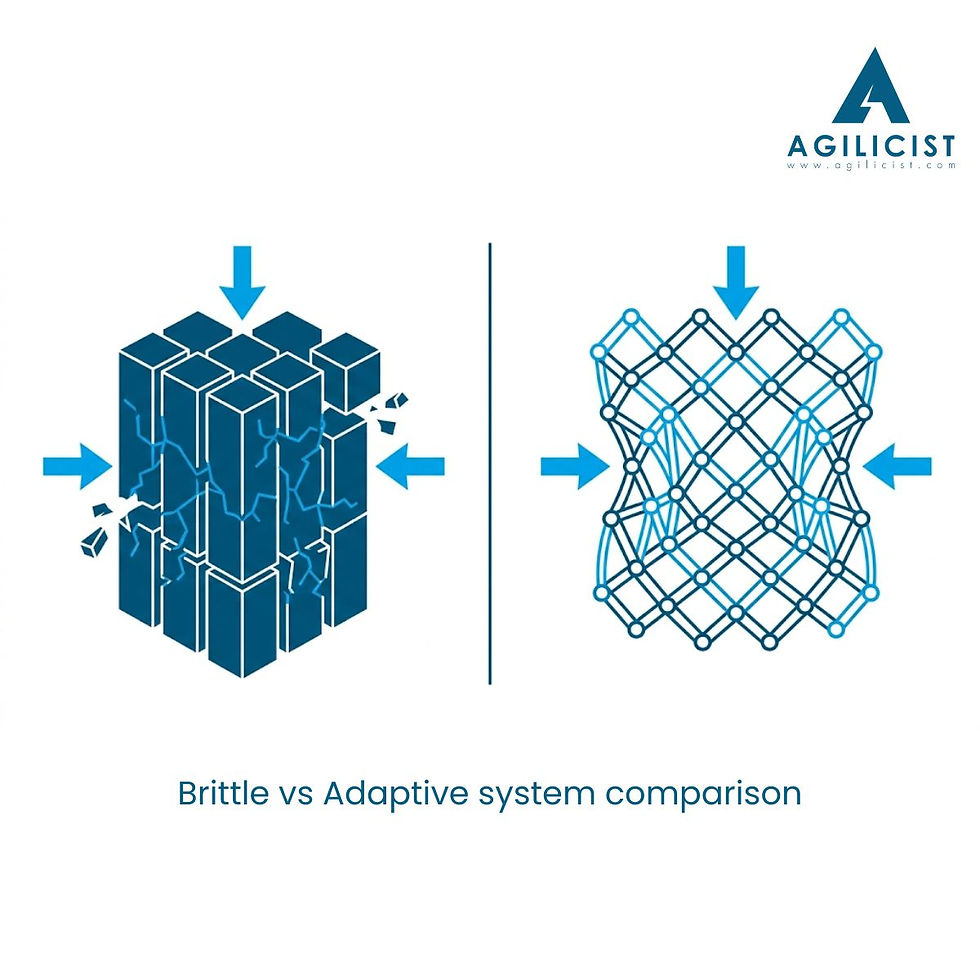
Control-heavy systems feel stable.
But in volatile markets, they are brittle.
They protect variance internally while amplifying risk externally:
Slow response to market shifts
Delayed return on capital
Locked capacity
Reduced strategic optionality
Re-optimisation is not simply an efficiency exercise. It is a structural risk mitigation strategy.
Adaptive systems do not increase risk; they reduce fragility.
Fragility is the hidden tax on capital efficiency.
Why Most Transformations Fail
Most transformation efforts fail not because they lack intent, but because they attack the visible layers:
New frameworks and ways of working
Cultural campaigns
Empowerment rhetoric
While leaving the optimisation logic untouched.
Funding remains annual and rigid.
Escalation remains the structural default.
Risk remains asymmetrically punished.
Stopping remains politically expensive.
So the system absorbs the change and reverts to its original optimisation logic.
You cannot transform outcomes without redesigning optimisation.
And you must redesign it deliberately.
The Principle of Managed Re-Optimisation
Re-optimising an enterprise is not a “big bang.”
It is a sequence of architectural decisions designed to:
Preserve capital integrity
Increase strategic throughput
Shorten response loops
Improve learning velocity
This is not decentralisation.
It is deliberate re-architecture.
The goal is Adaptive Stability.
Adaptive Stability means preserving capital discipline while increasing strategic responsiveness.
To achieve this without destabilising the enterprise, the sequence matters.
The Five Levers of Re-Optimisation (In Sequence)

1. Capital Allocation (The Foundation)
Everything begins with capital.
If funding remains locked in an annual cycle and fully allocated upfront, your organisation is structurally incapable of pivoting.
The Optimisation: Introduce Staged Commitment. Treat strategic bets as options rather than fixed-cost projects.
The Result: You protect the downside by funding in tranches, while expanding the upside exposure by allowing capital to follow value in real-time.
2 & 3. Decision Rights + Governance Clock Speed (The Response Loop)

Speed without control creates instability. Control without speed creates irrelevance.
The balance sits in the response loop.
2. Decision Rights
Control should shift from Approval to Guardrails.
Approval scales slowly. Guardrails scale infinitely.
The Optimisation: Move decisions closer to the knowledge. Define clear "non-negotiables" (Risk thresholds, regulatory guardrails, capital exposure limits) and allow teams to move autonomously within those boundaries.
The Result: Escalation is replaced by Systemic Clarity, removing the CEO as the ultimate bottleneck for mid-level trade-offs.
3. Governance Clock Speed
Not all decisions require the same cadence. Managing a 10-year infrastructure play with the same governance as a 3-month market experiment creates latency.
The Optimisation: Architect multiple "clock speeds" - Annual for infrastructure and regulatory commitments, quarterly for portfolio rebalancing, and continuous for delivery learning.
The Result: Governance becomes responsive. You shorten the gap between the signal and action; increasing speed without removing oversight.
4. Measurement (Strategic Traceability)
Systems optimise for what they measure. Measurement is not reporting. It is optimisation design.
If you measure activity, the system will produce activity. To re-optimise for outcomes, you must make the link between work and strategy undeniable.
The Optimisation: Every initiative or project must have Strategic Traceability - an explicit link to a board-level objective or strategic choice.
The Result: You eliminate "structural noise" and ensure that the system is measuring Impact, not just activity.
5. Designed Capacity Recovery (Sunset Mechanisms)

The hardest part of re-optimisation is not starting new work; it is stopping the old. Most enterprises accumulate commitments faster than they accumulate value.
The Optimisation: Institutionalise Capacity Recovery. Create a formal mechanism for sunsetting initiatives and projects that no longer serve strategic intent.
The Result: Capital and talent become fluid again, preventing the lack of optionality that occurs when resources are tied to legacy bets.
The Parallel Architecture: Reducing the Fear of Chaos
Executives resist re-optimisation because they imagine enterprise-wide destabilisation.
That is rarely required.
Instead, introduce a parallel architecture.
Select a clearly defined strategic portfolio - a “Pioneer” domain.
Choose an area where strategic uncertainty is high and learning velocity matters.
Apply the new optimisation logic there:
Staged funding
Accelerated governance cadence
Proximity-based decision rights
Designed sunset mechanisms
Allow the core business to remain under traditional controls.
This achieves three things:
Risk containment
Evidence generation
Organisational learning without systemic shock
Re-optimisation becomes demonstrable, not theoretical.
When performance improves in the Pioneer domain, expansion becomes a rational decision, not a cultural argument.

The Stability Paradox
Control-heavy systems optimise for internal predictability.
They feel stable, but they are brittle. They rely on the environment staying still.
Adaptive systems feel less predictable in the short term, but they are far more resilient because they respond faster than the environment shifts.
In a volatile market, brittleness is the greatest risk to capital.
Re-optimisation increases long-term stability by increasing the organisation’s structural permission to respond.
A Leadership Diagnostic
Ask your team these five questions at your next offsite:
Can £100k move to a higher-value opportunity without an annual reforecast?
Can a strategic priority pivot mid-cycle without exception governance?
Is our governance designed to enable performance or to audit compliance?
Do our teams have the authority to stop work that isn't delivering impact?
Is our capital allocated to projects (outputs) or to strategic options (outcomes)?
The answers define your Objective Function.
And your Objective Function determines your performance ceiling.
Re-optimisation is not a dramatic, high-risk event. It is a sequence of architectural decisions that align your structural DNA with your strategic intent.
You don’t transform an enterprise.
You redesign the logic that governs capital, authority, and response.
In the next article, we will examine the most powerful - and least understood - performance lever in the enterprise:
Capital architecture itself.
Because finance does not merely measure performance.
It defines the boundaries within which performance is possible.
This article is part of the Performance Architecture Series, exploring how organisations design for sustained performance.
Performance Architecture is a method created by Darren Emery. This article © Darren Emery 2026.


Comments