
Operating Flow: Why Most Enterprises Are Busy, But Still Behind
Updated: Aug 8

Part 9 of the Performance Architecture Series
In the previous article, we examined Decision Architecture: the structural logic of who gets to decide what, where, and under which conditions.
That matters because poor decision design creates hesitation, escalation, and approval theatre.
But even when decision rights improve, performance often still fails to shift.
Why?
Because decisions alone do not create outcomes.
Flow does.
This is the next layer of performance architecture: Operating Flow.
Most enterprises are not short of effort.
They are short of flow.
The problem is rarely that people are not working hard enough.
The problem is that value takes too long to move from idea to impact.
And that creates one of the most expensive illusions in enterprise performance:
The organisation looks productive while the strategy stalls.
The roadmap is full.
The teams are busy.
The dashboards are green.
The SteerCos are meeting.
The portfolio appears to be moving.
And yet somehow…
time to value remains slow
strategic priorities take too long to land
customers wait
opportunities expire
and innovation arrives after the market has already moved on
This is a flow problem.
The organisation has confused motion with throughput.
And the distinction is expensive.
The Busyness Trap
Most large organisations are not short of work.
They are drowning in it.
Projects.
Change requests.
Dependencies.
Transformation initiatives.
Governance actions.
Improvement plans.
Cross-functional asks.
Urgent strategic priorities.
Last-minute executive escalations.
Unplanned regulatory work.
And the relentless administrative tax required to coordinate it all.
From the inside, this often feels like productivity.
But motion is not flow.
A traffic jam is also motion.
Just not useful motion.
Productivity at component level does not guarantee throughput at system level.
In fact, in many organisations, it destroys it.
The organisation appears busy because every function is doing its part.
But the value itself is still stuck in transit.
What Operating Flow Actually Is
Operating Flow is the rate at which strategic intent converts into market impact.
It is not just an operational concern.
It is an economic performance metric.
Value has a shelf-life.
The longer it stays trapped inside your organisation, the more it decays:
revenue is deferred
opportunities pass by
feedback arrives too late to matter
risk remains live
Strategic intent that does not move is organisational inventory.
And inventory in a fast-moving market is a liability.
Most leaders miss this because they only experience delay in fragments - a blocked team here, a pending approval there.
But value does not experience your organisation function by function.
It experiences it end to end.
And from the market’s perspective, delay is cumulative.
Performance is not defined by how hard your people worked.
It is defined by how quickly value was allowed to move.
The Throughput Illusion
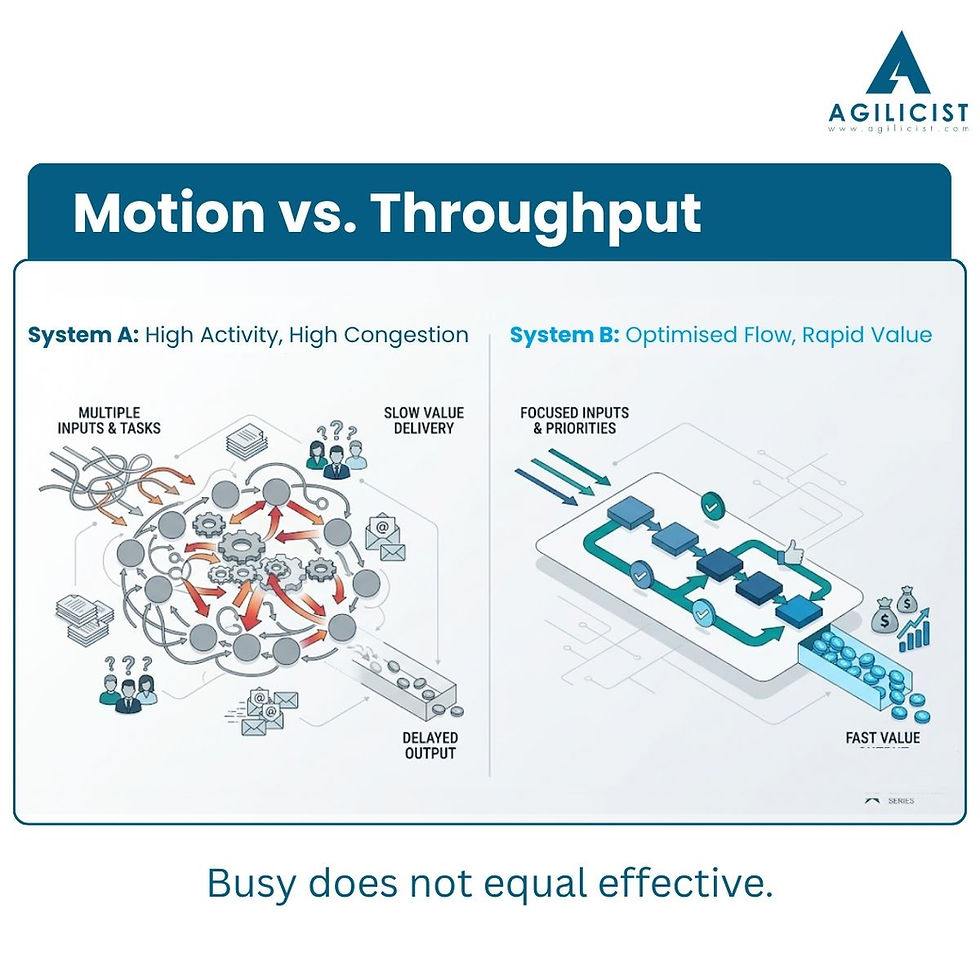
Many organisations believe they are improving performance when they are merely increasing visible activity.
This usually shows up in familiar ways:
More initiatives launched
More work in progress
More teams funded
More planning detail
More reporting
More governance touchpoints
More “alignment”
All of which can create the feeling of momentum.
But throughput is not measured by how much work enters the system.
It is measured by how much value exits it.
High-performing systems are defined by how reliably they finish what matters.
Most underperforming enterprises do not have a shortage of work entering the machine.
They have too much.
They have overloaded the system in the name of ambition.
The more work you push into an already constrained system, the slower the whole thing moves.
Because queues grow.
Dependencies multiply.
Context switching increases.
Coordination overhead rises.
And the cost of movement itself starts consuming capacity.
At that point, the organisation is no longer delivering value.
It is managing congestion.
Why Flow Breaks
Operating Flow breaks through the steady accumulation of structural friction.
1. Too Much Work in Progress (WIP)
When too many initiatives are active, nothing moves cleanly.
Strategic attention gets diluted.
Teams become spread thin.
Priorities compete for the same people.
Progress slows across everything.
This is not optionality; it is organisational self-interruption.
2. Cross-Functional Dependency Density
The more teams or approvals required to move something, the slower it becomes.
If value must queue through ten different functions before it can reach the customer, the system is broken by design.
3. Context Decay (The Translation Tax)
Every handoff introduces translation.
The original signal gets cleaned, reframed, softened, reworded, repackaged, and made “presentable” for the next silo.
By the time it reaches the team expected to execute it, one of two things has usually happened:
the original problem has lost its urgency
or the proposed solution has become detached from the problem entirely
This is how organisations end up delivering well against needs that no longer matter.
4. No One Owns the Queue
Most enterprises assign ownership to functions (delivery, architecture, product, engineering, finance, legal).
Very few assign ownership to flow itself.
Which means queues form everywhere:
work waiting for funding
work waiting for approval
work waiting for design
work waiting for specialist input
work waiting for prioritisation
work waiting for someone senior to decide
And because no single leader owns the end-to-end movement of value, delay becomes structurally normal.
It is everyone’s problem, which means it is no one’s responsibility.
That is one of the understated reasons large organisations stay busy while remaining slow.

The Cost of Invisible Waiting
One of the reasons flow is so poorly managed is because most organisations do not measure waiting.
They measure utilisation, milestones, delivery confidence, and forecast accuracy.
This is a mistake. Waiting is where performance is lost.
A strategic priority may technically take six months to deliver.
But the actual hands-on work might only account for six weeks of that time.
The rest is:
queue time.
approval time.
coordination time.
dependency time.
rework time.
decision time.
scheduling time.
“let’s take this offline” time.
This is a latency problem.
Latency ties up capital, delays learning, reduces option value, and keeps your best people occupied by work that has not yet earned the right to continue.
Value has a shelf life.
A feature delivered in 3 months might be worth £1M
The same feature delivered in 9 months might be worth £0 because a competitor got there first.
The market doesn’t send you an invoice for delay.
It just stops rewarding you.
Slack is the Prerequisite for Speed
Executives often confuse 100% utilisation with performance.
But systems do not become faster by being permanently full.
A motorway at 100% utilisation is a car park.
To move at 70mph, you need 30% empty space.
The same is true inside the enterprise.
When every team, specialist function, and roadmap is loaded to maximum capacity, the organisation loses its ability to absorb variation.
And variation is not an edge case.
It is reality.
A regulatory interruption.
A customer issue.
A production defect.
A strategic pivot.
A new market signal.
If the system has no slack, every disruption becomes a queue.
Slack is not waste.
Slack is response capacity.
It is the difference between an organisation that can absorb reality…
and one that collapses into queueing the moment reality shows up.
Local Efficiency vs. Global Flow
This is one of the most important ideas in the entire series.
Most enterprises are managed functionally.
And functions are rewarded for local efficiency.
Finance wants discipline.
Security wants safety.
Architecture wants integrity.
Operations wants stability.
Delivery wants predictability.
Engineering wants technical quality.
Procurement wants commercial control.
This is the trap of local optimisation.
Each part of the system gets better at doing its own job…while the whole system gets worse at moving value.
The enterprise becomes professionally managed and commercially sluggish.
You end up with the most efficient Procurement department in the world that takes six weeks to approve a tool the team needs today.
That is the trade most organisations make without ever admitting it.
And this is why enterprises can improve maturity, controls, governance, planning, and delivery process…
…and still get slower.
Because they have optimised for component performance, not system throughput.
And throughput is what the market experiences.
Not your internal maturity model.

Flow Is a Leadership Problem, Not a Team Problem
Leaders often see slow delivery and assume the issue lives with teams. They respond with "better" tooling, planning, and reporting.
All of which may improve local execution.
But teams do not create enterprise congestion.
They inherit it.
They inherit overloaded portfolios, fragmented structures, specialist bottlenecks, approval-heavy models, and dependency-rich designs they did not choose.
Then leadership asks them to “go faster.”
Blaming teams for slow flow is like blaming the exhaust for the traffic jam.
This is why so many delivery transformations plateau.
Because the real constraint was never team capability.
It was enterprise flow.
And flow is shaped upstream by leadership choices:
how much work is started
how funding is allocated
how decisions are made
how governance is designed
how specialist functions operate
how dependencies are tolerated
how stopping is handled
and how value is structured
In other words:
Flow is not a delivery problem.
It is an executive design responsibility.
What Leaders Mistake for Flow
One of the reasons operating flow remains poorly managed is that leaders often track the wrong signals.
They monitor signs of activity and mistake them for signs of throughput.
Here is the difference:
What Progress Looks Like | What Actually Indicates Flow |
High meeting attendance | Faster cycle time from idea to outcome |
100% Resource Utilisation | Available capacity to respond and pivot |
Long “In Progress” lists | More work completed and validated |
Heavy pre-alignment | Fewer approval handoffs |
Functional specialisation | Cross-functional movement of value |
High reporting cadence | Faster decision-to-delivery conversion |
The point is not that visibility, planning, or coordination are bad.
The point is that they are not the same thing as movement.
And many enterprises have become very good at reporting on work that is barely moving at all.
The Executive Failure Mode
Enterprises do not intentionally destroy flow.
They do it while trying to be responsible.
They want:
full visibility
better planning
stronger control
clear accountability
efficient resource use
low risk
high certainty
But when all of those goals are pursued without regard for flow, the result is predictable.
The organisation becomes very good at managing work.
And very slow at delivering value.
Which is why so many enterprises can produce immaculate status reporting on initiatives that should probably have been stopped three months ago.
That is the executive failure mode: a system designed to maximise control at the expense of throughput.
A Simple Diagnostic for the Executive Team
At your next leadership session, ask:
1. Where does value wait longest in our system?
2. What percentage of elapsed time on a major initiative is actual value-creating work?
3. How many “top priorities” are currently competing for the same constrained people or functions?
4. Which parts of our operating model create the most queueing?
5. Where does work get reinterpreted, repackaged, or re-approved?
6. What are we measuring more closely: utilisation or throughput?
7. Which strategic priorities are slow not because they are difficult, but because the system makes them travel too far?
Those answers will tell you more about enterprise performance than a delivery dashboard ever will.
Because if value cannot move, strategy cannot land.
And if strategy cannot land, performance remains theoretical.
The Reframe
Most organisations do not need more productivity.
They need less structural friction.
They do not need more work started; they need more work finished.
They do not need more activity; they need more throughput.
Because performance is not determined by how much effort exists inside the system.
It is determined by how quickly value can move through it.
Capital may fund the bet.
Governance may permit the move.
Decision architecture may clarify authority.
But if value still cannot move through the enterprise fast enough, performance remains theoretical.
And that is the real test of operating design:
Can the organisation convert intent into impact before the market changes its mind?
If not, the issue is not motivation.
It is not commitment.
It is not whether people “care enough.”
It is flow.
And slow systems do not lose because they lack ambition.
They lose because the market does not wait.
Next step
In the next article, we’ll go one level deeper into one of the most expensive flow killers in the modern enterprise:
Dependency Architecture - why so many organisations structure work in ways that make speed structurally impossible.
Because once you start seeing flow clearly, the next question becomes difficult to ignore:
Why is so much value structurally dependent on teams, functions, and approvals that were never designed to move at the same speed?
That is where flow usually breaks hardest.
And it is where we go next.
This article is part of the Performance Architecture Series, exploring how organisations design for sustained performance.
Performance Architecture is a method created by Darren Emery. This article © Darren Emery 2026.


Comments